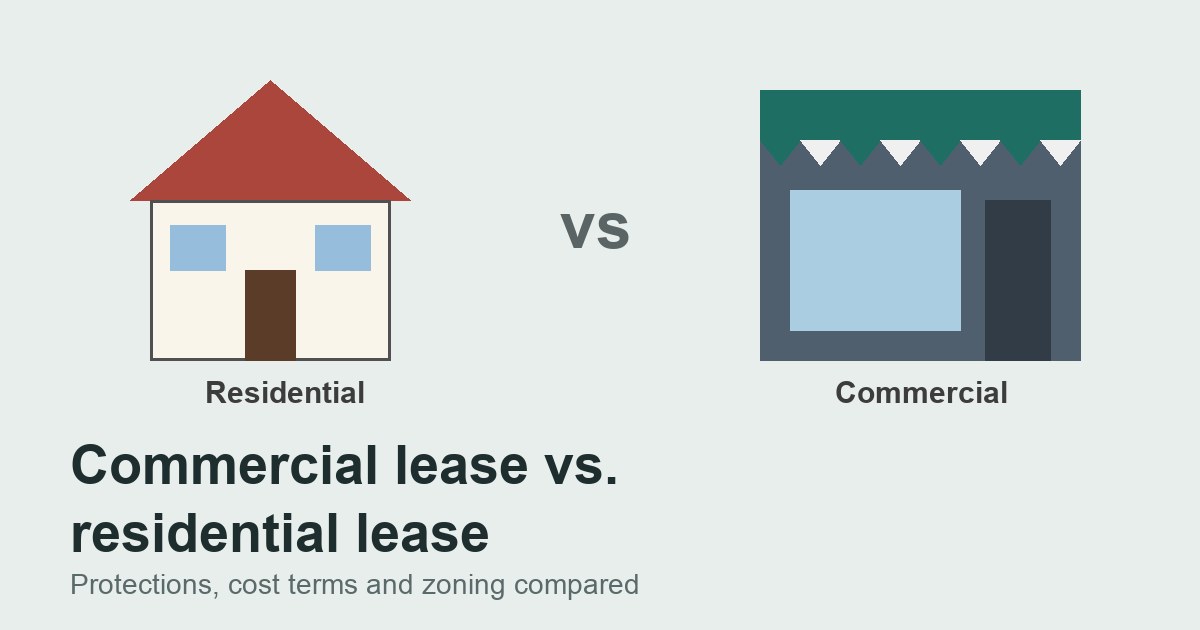
Commercial Lease vs. Residential Lease: Key Differences to Understand
A lease grants someone the right to possess and use property for a period in exchange for consideration, often rent. Leases can involve homes, apartments, offices, stores, warehouses, equipment, or vehicles. The phrase “lease” is the same in each situation, but the legal setting and the issues to review can differ substantially.
This guide compares commercial and residential leases in general terms. It is not legal advice. Lease rights and obligations depend on the agreement, the property, and applicable state and local law. Anyone about to sign or enforce a lease may want a qualified professional in the relevant jurisdiction to review the documents.
The basic difference: how the space is used
A residential lease generally covers a place where a person lives. A commercial lease generally covers space used for business purposes. Cornell Law School’s Legal Information Institute notes that real property leases can involve residential or commercial premises and are generally regulated under landlord-tenant law.
The use matters because some legal protections and practical concerns are tied to housing. A household renting an apartment may be focused on safety, repairs, and living conditions. A business renting a store may also need to consider customer access, signage, zoning, buildout, permitted business activities, and the costs of operating the premises.
Housing protections can be different
Landlord-tenant law covers both residential and commercial rentals, but residential tenants may have protections that do not apply in the same way to a business lease. Cornell’s Legal Information Institute explains that the implied warranty of habitability applies to residential leases and is recognized in most U.S. jurisdictions. It generally requires rental housing to be safe and fit for human habitation even if the lease does not expressly require repairs.
Cornell’s summary also says residential landlords generally must provide habitable housing that complies with local codes. Tenant remedies for habitability problems may include repair requests or court action, depending on the jurisdiction. Some places also limit retaliatory evictions.
Those rules are not a complete list of residential protections, and they vary by location. The key point is that a residential lease is usually read alongside housing-focused law. A business tenant should not assume that a residential protection automatically applies to commercial space.
Cost terms may look different
Residential and commercial leases can both include rent, deposits, utilities, and maintenance terms. A commercial lease, however, may allocate additional building costs to the tenant. The Legal Information Institute describes a triple net lease, or NNN lease, as normally commercial. Under that structure, the tenant pays insurance, maintenance, and taxes in addition to rent and utilities.
The same source notes that a triple net tenant may bear unexpected maintenance costs or tax increases unless the agreement limits those obligations. This does not mean every commercial lease is a triple net lease, and terms vary. Still, it shows why a commercial tenant should identify every cost assigned by the lease rather than focusing only on base rent.
Zoning and permitted use
A commercial tenant may need to confirm that the property can lawfully be used for its intended business. The U.S. Small Business Administration advises business owners who buy, rent, or build a location to check that it conforms to local zoning requirements. It also notes that zoning rules can restrict or prohibit certain types of businesses in an area.
A lease may include its own “use clause” that limits what the tenant can do in the space. Zoning approval and lease permission are separate questions. A business should consider both before committing.
Questions to ask before signing
For either kind of lease, read the entire agreement and keep a signed copy. Useful questions include:
- What space is included, and when does possession begin?
- How long is the term, and how can it renew or end?
- What rent and other costs must be paid, and when?
- Who handles repairs, maintenance, insurance, utilities, and taxes?
- What uses are permitted?
- Can the space be altered, subleased, or assigned?
- What notice is required for problems or termination?
For a commercial lease, a business may also ask about zoning, signage, buildout, access, and any personal guarantee requested from an owner. For a residential lease, a tenant may want to understand repair procedures and local housing rights.
Bottom line
Commercial and residential leases share a basic structure, but they serve different purposes. Residential leases are closely tied to housing protections, while commercial leases often require careful review of negotiated business terms, operating costs, permitted use, and zoning. Understanding which kind of lease you are signing is a useful first step.
Sources
- Cornell Law School Legal Information Institute, “Lease”: https://www.law.cornell.edu/wex/lease
- Cornell Law School Legal Information Institute, “Landlord-Tenant Law”: https://www.law.cornell.edu/wex/landlord-tenant_law
- Cornell Law School Legal Information Institute, “Implied Warranty of Habitability”: https://www.law.cornell.edu/wex/implied_warranty_of_habitability
- Cornell Law School Legal Information Institute, “Triple Net Lease”: https://www.law.cornell.edu/wex/triple_net_lease
- U.S. Small Business Administration, “Pick your business location”: https://www.sba.gov/business-guide/launch-your-business/pick-your-business-location